
cancer cure
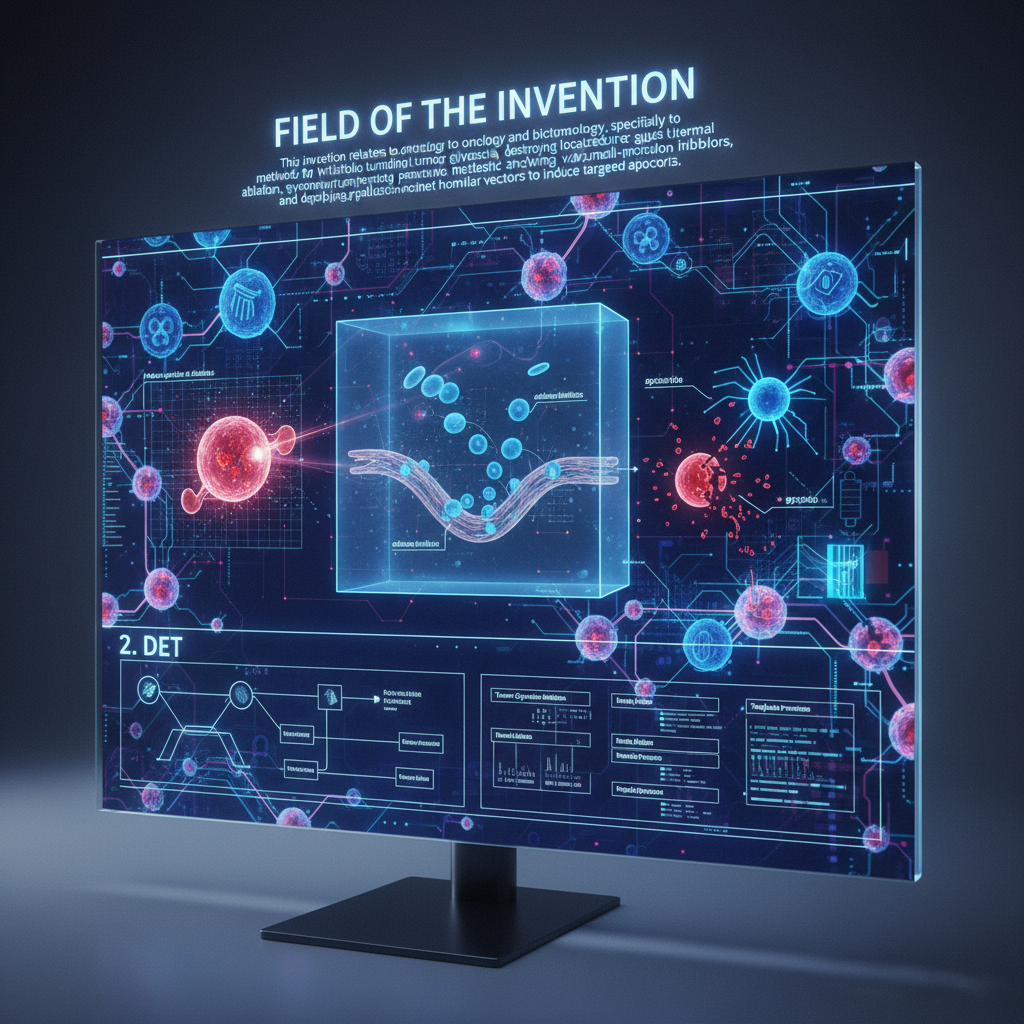
1. FIELD OF THE INVENTION This invention relates generally to oncology and biotechnology, specifically to methods for inhibiting tumor glycolysis, destroying localized tumor masses via image-guided thermal ablation, systemically preventing metastatic anchoring via small-molecule adhesion inhibitors, and deploying replication-incompetent homing cellular vectors to induce targeted apoptosis. 2. DETAILED SPECIFICATION OF THE INVENTIVE CLAIMS PHASE 1: THE METABOLIC PRESS (Glucose-Transport Blockade) The system competitively binds structural glucose analogues, specifically 2-Deoxy-D-Glucose (2-DG), to overexpressed GLUT1 surface receptors on the malignant plasma membrane [A1]. Once internalized, intracellular hexokinase phosphorylates the analogue into 2-DG-6-Phosphate [A1]. Because it cannot be processed further via phosphoglucose isomerase, the molecule induces downstream allosteric feedback inhibition of hexokinase, jamming the cell's energy production line and creating a localized metabolic fuel crisis [A1]. PHASE 2: THE CRYOGENIC STRIKE (PET-Guided Thermal Eradication) Following metabolic stress induction, an intravenous fluorodeoxyglucose (FDG) radiomarker is introduced to map highly glycolytic regions via a PET scan loop. Percutaneous cryoablation probes are then advanced to the mapped target coordinates. Argon gas drops the temperature below -40°C to form a necrotizing ice ball, physically rupturing cell walls and spilling unmasked tumor antigens directly into the bloodstream to trigger a systemic native immune T-cell response. PHASE 3: THE ANTI-ADHESION SHIELD (Vascular Metastasis Blockade) To prevent surviving circulating tumor cells (CTCs) from anchoring to secondary tissues, systemic small-molecule integrin and selectin inhibitors are introduced alongside selective Galectin-3 blocks (such as Belapectin). These molecules chemically coat the micro-hooks and sugar glues on traveling cancer cells, creating a non-stick environment inside the blood vessels that leaves loose cells isolated and exposed to natural killer (NK) cell clearance. PHASE 4: THE CYTOTOXIC HOMING CELL (CRISPR Reprogrammed Vector) Autologous tumor cells are harvested and engineered via CRISPR-Cas9 to permanent
Overall Score
77/100
AI Summary
This innovation involves a multi-phase approach to cancer treatment, combining metabolic blockade, cryogenic ablation, adhesion inhibition, and CRISPR-enhanced cellular therapy.
Strengths
- ✓ The integration of tumor glycolysis inhibition, image-guided thermal ablation, adhesion inhibitors, and CRISPR-based therapies offers a unique value proposition, potentially capturing a significant share of the growing oncology market.
-
FIELD OF THE INVENTION This invention relates generally to oncology and biotechnology, specifically to methods for inhibiting tumor glycolysis, destroying localized tumor masses via image-guided thermal ablation, systemically preventing metastatic anchoring via small-molecule adhesion inhibitors, and deploying replication-incompetent homing cellular vectors to induce targeted apoptosis.
-
DETAILED SPECIFICATION OF THE INVENTIVE CLAIMS
PHASE 1: THE METABOLIC PRESS (Glucose-Transport Blockade) The system competitively binds structural glucose analogues, specifically 2-Deoxy-D-Glucose (2-DG), to overexpressed GLUT1 surface receptors on the malignant plasma membrane [A1]. Once internalized, intracellular hexokinase phosphorylates the analogue into 2-DG-6-Phosphate [A1]. Because it cannot be processed further via phosphoglucose isomerase, the molecule induces downstream allosteric feedback inhibition of hexokinase, jamming the cell's energy production line and creating a localized metabolic fuel crisis [A1].
PHASE 2: THE CRYOGENIC STRIKE (PET-Guided Thermal Eradication) Following metabolic stress induction, an intravenous fluorodeoxyglucose (FDG) radiomarker is introduced to map highly glycolytic regions via a PET scan loop. Percutaneous cryoablation probes are then advanced to the mapped target coordinates. Argon gas drops the temperature below -40°C to form a necrotizing ice ball, physically rupturing cell walls and spilling unmasked tumor antigens directly into the bloodstream to trigger a systemic native immune T-cell response.
PHASE 3: THE ANTI-ADHESION SHIELD (Vascular Metastasis Blockade) To prevent surviving circulating tumor cells (CTCs) from anchoring to secondary tissues, systemic small-molecule integrin and selectin inhibitors are introduced alongside selective Galectin-3 blocks (such as Belapectin). These molecules chemically coat the micro-hooks and sugar glues on traveling cancer cells, creating a non-stick environment inside the blood vessels that leaves loose cells isolated and exposed to natural killer (NK) cell clearance.
PHASE 4: THE CYTOTOXIC HOMING CELL (CRISPR Reprogrammed Vector) Autologous tumor cells are harvested and engineered via CRISPR-Cas9 to permanent